Stress travels sideways.
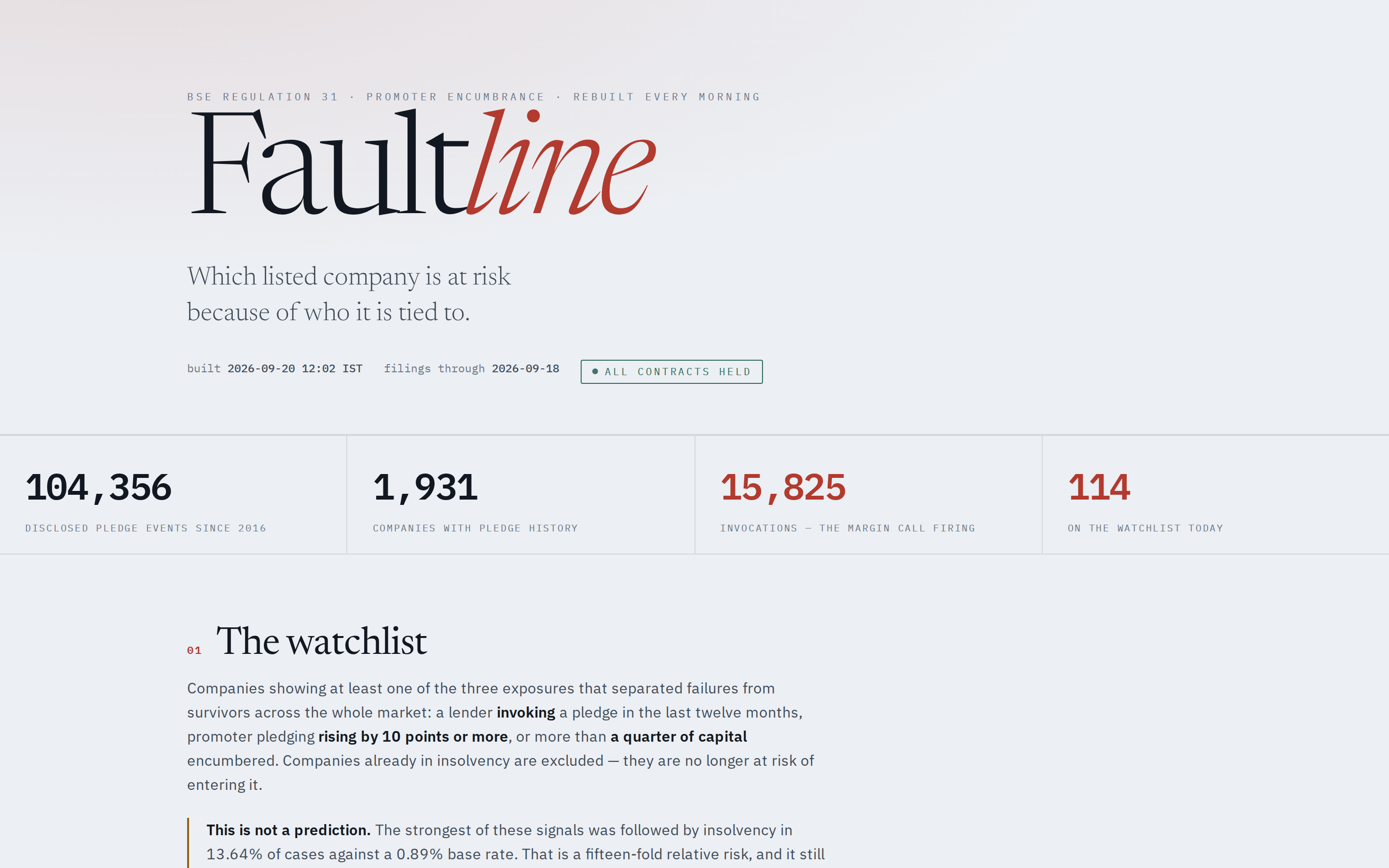
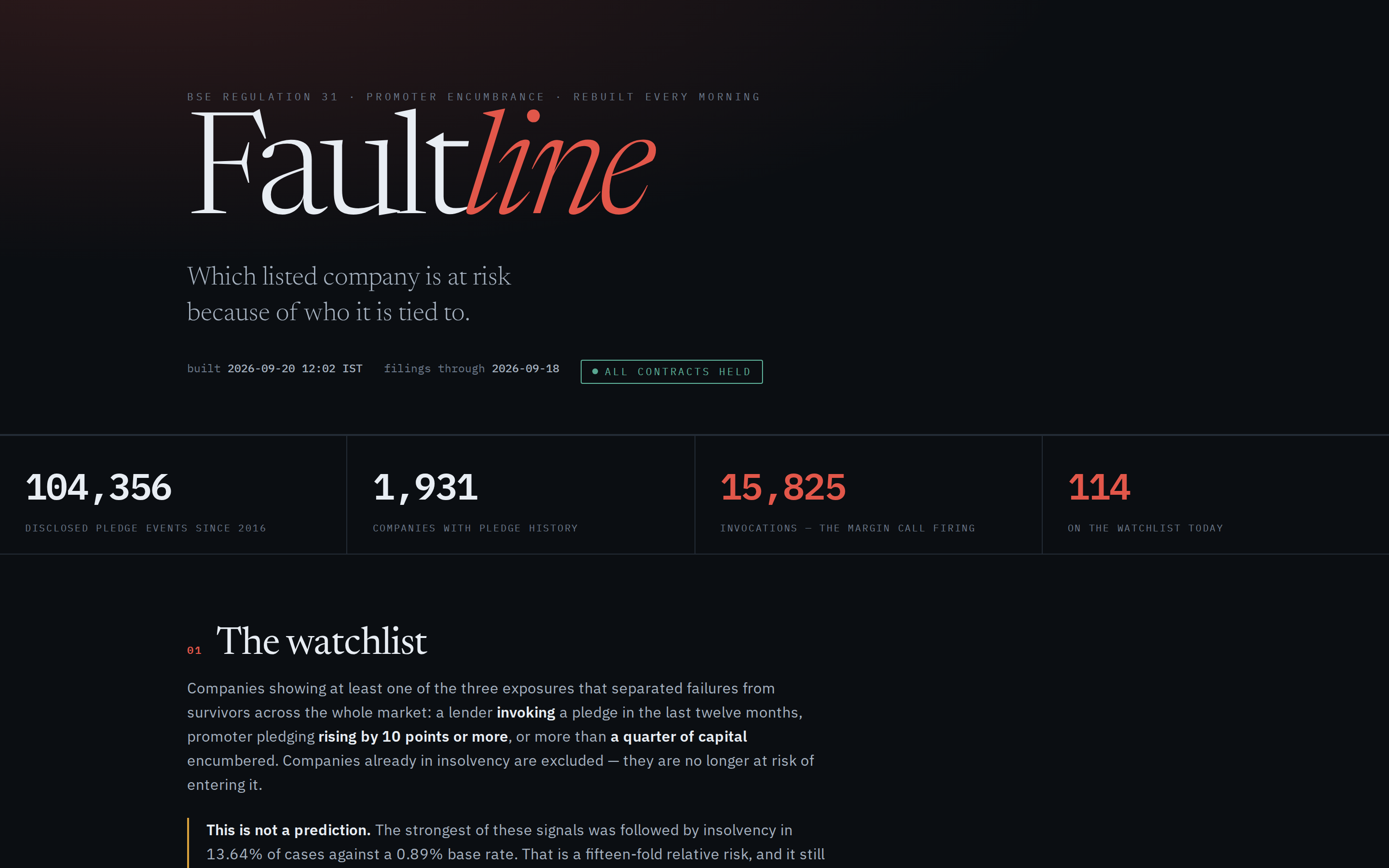
Indian promoters pledge their shares. When one company comes under pressure the margin call lands on the promoter, who is also the promoter of four other listed companies — so the stress moves sideways through the shareholding rather than through any balance sheet. Faultline reconstructs those ties from BSE disclosures and publishes, every morning, the companies currently carrying the signal.
The null result that was really a sampling problem
Ranked by how much of a company was pledged, the first version of this caught 2 of 23 eventual insolvencies in the top 5% — and did worse than chance at the top 10%. The reason was the sample: the disclosure feed it drew on only contains companies that have already crossed an encumbrance threshold, so every company in it was already heavily pledged. Conditioning on the disclosure conditions on the outcome.
Widening the denominator reverses it
Checking all 5,836 listed scrips instead of the 439 that had filed — so a company with no pledges is a measured zero rather than one nobody asked — the same tests separate sharply. A lender invoking a pledge in the prior twelve months carries 15× the insolvency rate, and the effect shows up independently in every year that has the events. The signal was never absent; the denominator was.
A finding that dissolved under audit
Contagion through a shared lender came back at 8.0× with p = 0.027 — the central hypothesis apparently landing. The lenders doing the work turned out to be debenture trustees, who hold security on behalf of bondholders and of whom four firms serve the entire Indian market. Sharing one means both issued secured debt, not that either is exposed to the other. Excluding them, the effect is exactly zero.
A percentage that meant two different things
The column giving each promoter's pledged share means a fraction of total capital for some filers and a fraction of that promoter's own holding for others. Summed across promoters it put 137 companies above 100% pledged and one at 1,439%, silently, because no individual value looks wrong. It is now derived from share counts and checked against the exchange's own figures every morning.